

Betiator is a crash-style betting game built by Delasport that runs inside a live soccer match. It doesn't work on NHL, CFL, or NBA games, because its two triggers, corners and goals, are events that only exist in soccer.
Inside a match, a bettor picks a stake and a trigger, then watches a multiplier climb until that trigger lands or they cash out first, whichever comes sooner. The round is tied to whatever match is live at the time, including Simulated Reality League (SRL) fixtures when no real match is on. Cash-out gets switched off during a dangerous attack or a penalty, and staying in the round longer can unlock a bonus boost on top of the multiplier. Betiator reaches players through sportsbook operators running on the Delasport platform. One figure repeated later on this page, a tracked live round, is shown in euros because that's the currency it was measured in; every other example below uses Canadian dollars.
Quick Facts
| Attribute | Detail |
|---|---|
| Provider | Delasport |
| Available via | Sportsbook operators on the Delasport platform |
| Works on | Live soccer matches, real or simulated, not hockey, CFL, or basketball |
| Trigger options | Corners or goals, chosen before the round starts |
| Cash-out | Available any time before the trigger event, unless blocked |
| Cash-out blocked during | Dangerous attacks and penalties |
| Currency shown in this guide | CAD for illustrative stakes; the one measured round is shown in EUR, as recorded |
| Comparable game | Crash-style, event-triggered betting |
On This Page
- What Betiator Actually Is
- Does Betiator Work on Hockey, CFL, or the NBA?
- How to Find Betiator: Step by Step
- Playing a Round: Step by Step
- Corners vs Goals: Picking Your Trigger
- Cash-Out Windows: When the Button Goes Dark
- Bonus Boosts: How the Mechanic Works
- Betiator Bonus: What's Actually on Offer
- A Measured Round: What the Multiplier Growth Looked Like
- Betiator vs Aviator: What's Actually Different
- Betiator vs a Same Game Parlay: A Different Kind of Bet
- Simulated Reality League: Filling the Gaps Between Real Matches
- Where to Play Betiator in Canada
- Is Betiator Available in Canada? Licensing by Province
- Age Requirements and Responsible Gambling in Canada
- Is There a Way to Predict When Betiator Will Crash?
- Betiator Questions, Answered
What Betiator Actually Is
Betiator sits inside the live match viewer, on the same page where a bettor is already watching a soccer game, rather than opening as a separate app or a stand-alone slot. Delasport, the company behind it, builds the widget directly into that page, so there's nothing extra to download and nothing to leave in order to play a round.
The loop will feel familiar to anyone who has tried a crash game before: stake an amount, watch a number climb, decide when to lock in a win. What Betiator changes is what decides the crash point. Most crash gambling runs on a random number generator, a figure with no connection to anything happening outside the game itself. Betiator's crash point is a live soccer event instead, a corner or a goal, whichever the bettor picked as the trigger. Nothing hidden sets the outcome ahead of time. The match does.
Because a round needs an actual match in progress, complete with a referee, a scoreboard, and stoppage time, Betiator only runs on fixtures that are currently live, real or simulated. A round can't be opened before kickoff, and it doesn't run on a fixed clock the player sets. It ends the instant the chosen trigger happens, whether that's four seconds into the round or deep into the second half.
That's also the plainest way to explain why the game appeals to people who already follow live soccer: the event deciding the round is one they'd be watching regardless, not an abstraction spinning in a separate window. Worth stating up front, since it shapes every section below: because the trigger is a real event on the pitch, it can land at any point, including within seconds of the stake going down. Nothing in the mechanic guarantees a minimum round length.
Does Betiator Work on Hockey, CFL, or the NBA?
No. Betiator only works on soccer, because both of its triggers, corners and goals, are events specific to that sport and don't exist in the same form in hockey, Canadian football, or basketball.
That's worth spelling out plainly for a Canadian reader, because "football" doesn't mean the same thing here that it does in most of the world. Outside North America, "football" is soccer, and a corner kick is a routine part of the game. In Canada, "football" defaults to the CFL or the NFL, where there's no corner and no equivalent trigger event Betiator could hook into. So when this guide says soccer, that's the deliberate word, not a British import: Betiator's mechanic is built around soccer specifically, whatever the local name for it happens to be.
The same gap shows up across the sports Canadians actually bet on most. NHL player props, a huge category on its own, has no analogue here, hockey doesn't produce corners or the same kind of discrete goal event a crash mechanic could crash on cleanly, and there's no version of Betiator built for it. CFL betting runs into the same wall: a Canadian football possession ends in a punt, a turnover, or a score, none of which map onto "corner" or "goal" the way soccer does. The NBA has neither.
Where the mechanic does apply, and applies honestly, is MLS betting and the wider Canadian soccer scene, MLS clubs, Canadian Premier League matches, and international soccer fixtures airing here. That's the sport Betiator is actually built for, and it's a smaller slice of what Canadian bettors follow than hockey or the CFL, which is exactly why this question needs answering up front rather than three sections in. A hockey or CFL bettor opening this page expecting a hockey-flavoured version of Betiator won't find one, and there isn't one coming, because the mechanic depends on events that only happen in soccer.
How to Find Betiator: Step by Step
Finding Betiator isn't as obvious as tapping a bet slip. It doesn't live in a slots lobby, and it isn't its own listed market in the main betting menu, so a Canadian bettor used to a straight moneyline click needs a slightly different path to actually reach it.
- Open the live betting section. Every operator carrying Betiator has a "Live" or "In-Play" tab in the main navigation. Start there, not in the casino section.
- Go to the list of live events. This is the scoreboard-style overview most sportsbooks default to, every sport and league currently in play stacked in one long list.
- Pick the league. Betiator only runs on soccer, so that means a soccer league specifically, not the NHL scoreboard sitting a few rows above it or the CFL fixture further down the page.
- Find the match. Any live soccer fixture works, an MLS game, a Canadian Premier League match, an international fixture airing here, or an SRL simulation if nothing real is on at that hour.
- Open the match and look right. Once a specific fixture is selected, a widget shows up in the right-hand column of that event page. That's Betiator: the Corners and Goals trigger tabs, a stake field, and the bet button all sit there.
The screen above is what a player sees before Betiator shows up anywhere, a plain list of fixtures with no sign of the game. That's expected, not a glitch. The widget doesn't render on the scoreboard view at all.
Tapping into one match, as above, is what changes the screen. The scoreboard gives way to a single match view, and the widget sits in the right-hand column of that page, alongside the regular markets.
That last screenshot is the whole game in one panel: pick Corners or Goals, set a stake, and the round starts running against whatever's happening in the match on screen. For a bettor whose muscle memory runs on hockey and CFL menus, the one thing worth remembering is which sport to look under. Betiator only shows up on soccer fixtures, so scrolling past the NHL and CFL sections in the live list isn't a wrong turn, it's just where the game doesn't live.
Playing a Round: Step by Step
A round runs through the same sequence every time: stake, pick a trigger, watch the multiplier climb, cash out or don't, then find out whether the match beat you to it.
- Pick a live match and set a stake. Betiator only opens on a match currently in progress, real or SRL. Stakes come from preset chips, commonly $5, $10, $25, or $50, or a custom amount, confirmed with a "Place Bet" button.
- Choose the trigger. Two tabs sit above the multiplier: Corners and Goals. Whichever tab is selected decides what ends the round, and it's the single biggest lever a player has over how a round plays out.
- The multiplier climbs. Once the stake is placed, the number ticks upward for as long as the chosen event hasn't happened in the match.
- Cash out any time the button is live. The stake button turns into a cash-out button showing the current potential payout. Tapping it locks in that multiplier.
- Watch for the blocked window. During a dangerous attack or a penalty, cash-out switches off automatically until the match settles. This is the part that separates crash betting on Betiator from an ordinary RNG crash game, and it's covered on its own below.
- The round settles one of two ways. Either the bettor cashes out before the trigger event and the multiplier at that moment becomes the payout, or the corner or goal happens first and the stake is gone. There's no partial outcome. A separate "cancelled" status exists for a voided bet, distinct from either a win or a loss.
Step 5 is what makes this different from most crash gambling. A typical crash title runs on a clock and a random draw, with nothing between "still climbing" and "crashed." Betiator inserts a third state, a stretch where the round is technically live but the player can't act on it, because whatever is unfolding on the pitch, a corner about to be swung in, a penalty being set up, is happening in real time and can't be paused for a decision.
Corners vs Goals: Picking Your Trigger
Corners and goals aren't two settings on the same bet. They're two different bets, with different risk profiles, and Betiator makes a player choose one before the round even opens.
Picking Corners means the round ends the next time either side wins a corner. Corners come around often in a typical match, a deflected clearance, a keeper punching a cross out, a team pressing down the flank all count, and a full match usually produces somewhere around ten of them between both sides. That frequency is exactly why corner-trigger rounds tend to be short. There's not much room for the multiplier to build before the round is statistically likely to end, and against a team that's already pressing hard, a corner-trigger round can end within the first few minutes.
Picking Goals flips that. Goals are rare next to corners, most matches produce two or three across ninety minutes, some go a full half without one. A goal-trigger round can run far longer before anything forces a settlement, which is what lets the multiplier climb higher for a player willing to sit through it. It also means longer exposure to the stretches where cash-out gets blocked, since a team pushing hard for a goal usually means a dangerous attack isn't far behind. The wider betting vocabulary around who scores next, an anytime goalscorer market, for instance, sits in the same territory: goals are the scarce event in soccer, and everything built around predicting them, Betiator's Goals trigger included, inherits that scarcity.
Neither option is better outright. They suit different ways of watching a match. A player who'd rather see a round resolve fast and doesn't mind a modest multiplier gets that from Corners. A player comfortable watching longer stretches, accepting that the wait also brings more blocked windows, gets more room to grow from Goals.
One detail worth knowing before committing: the trigger choice is locked in at the moment of the stake and holds for the entire round. If the match tilts into an end-to-end stretch with corners flying in at both ends, that's the environment a Goals-trigger round is now playing out in, for better or worse. Reading the shape of a match, a team camped in the final third versus an even, back-and-forth contest, says more about what to expect than any fixed rule could.
Cash-Out Windows: When the Button Goes Dark
Cash-out betting on Betiator isn't available every second the round is live. During a dangerous attack or a penalty, the cash-out button switches off until the match calms back down, and that single mechanic is what separates Betiator from the rest of the crash genre.
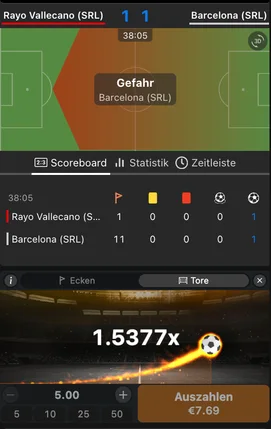
The interface makes the state visible rather than hiding it. When the match enters a dangerous spell, the round shows a "Danger" label, the play area turns orange, and the cash-out button goes dark, unpressable no matter how badly a player wants to lock in a multiplier. Once the danger passes, the state flips back to safe, the colour returns to green, and cash-out becomes available again.
Why build a game around a stretch where the player can't act? Without it, cash-out betting here would be trivially exploitable: anyone watching the broadcast could cash out in the half-second before a corner or a penalty registers, turning the game into a race against stream delay rather than a bet on the match. Locking cash-out during exactly those moments closes that loophole, and it also turns the tensest passages of a match, a corner about to be swung in, a penalty about to be taken, into stretches a player has to sit through rather than dodge.
That changes what strategy actually means here compared to a standard crash game, where cash-out is available at any instant right up until the crash. On Betiator, the safest moment to act is when the match is calm, not necessarily when the multiplier looks best. A meaningful part of playing well is reading the state of the match itself: is the ball in a dangerous area right now, or isn't it? Most of what people call skill at cash out betting on this game is really just watching that question a beat before the danger label does.
Here's the catch, stated plainly. Because danger windows cluster around exactly the moments a goal or corner is most likely, the trigger event can land during a stretch where there was no way to cash out even if a player wanted to. That's not a glitch, it's the mechanic working as designed. The practical takeaway is to treat rising pressure as an early signal rather than a late one: if a match is building toward a corner and cash-out is still green, that's the window to decide, before the danger label appears and takes the choice away.
Bonus Boosts: How the Mechanic Works
Bonus boosts add extra percentage points on top of the current multiplier the longer a stake survives without its trigger event happening. The mechanic runs quietly in the background of every round; nothing needs to be activated, survival time alone moves it along.
A short corner-trigger round that resolves in the first minute rarely reaches a boost step at all. A longer goal-trigger round that survives several danger windows gives the mechanic more time to work through its steps. Delasport's own product material shows the boost counter climbing through named stages with a countdown to the next one, alongside chip sets and stake ranges that vary by where the game is deployed, a sign the surrounding setup is configured per operator even where the stage sizes themselves aren't. What isn't published anywhere, demo included, is the exact rule for how much survival time moves the counter from one stage to the next. If a boost does apply, it shows up directly in the multiplier the next time the cash-out figure is checked, with no separate screen to track down.
The mechanic rewards the same behaviour a Goals-trigger round already rewards: staying in longer. It adds a small extra factor to the corners-versus-goals decision covered above without changing the underlying fact that a round can still end at any moment, boost or no boost.
Betiator Bonus: What's Actually on Offer
Betiator itself doesn't carry a standing welcome bonus, deposit match, or free-bet offer wired into the game. What it does have is the boost mechanic covered just above, and it's worth being precise about the difference, because a Betiator bonus search usually turns up two separate things that get lumped together.
The first is the built-in boost: Delasport's own product material shows it climbing in three named stages, +5%, then +10%, then +15% on top of the multiplier, each one arriving after a countdown that only completes if the stake is still alive when it does. No code, no opt-in, nothing to activate on an account, it runs in the background of every round on its own. The stage sizes above are what's actually published; how many seconds each countdown takes to complete is the part that isn't, as noted in the section above, and likely varies by operator along with the rest of the deployment settings.
The second is whatever promotion the sportsbook carrying the game happens to be running at the time, a deposit bonus, a free bet, a loyalty offer. None of that is specific to Betiator, and none of it comes from Delasport. It sits entirely with the operator, changes on the operator's own schedule, and varies by province and by sign-up terms. Nothing on this page holds as a fixed figure for long, so checking the promotions page of whichever sportsbook is actually being used is the only way to see what's live today rather than what was live when this was written.
A Measured Round: What the Multiplier Growth Looked Like
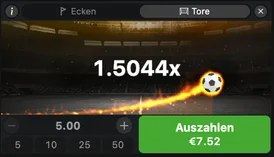
One live round has been tracked in detail for this guide, and the figures below are shown in euros because that's the currency the round was recorded in, not Canadian dollars. It was a €5 stake, trigger set to Goals, on a Simulated Reality League match between Rayo Vallecano and Barcelona, tied 1-1 at the time.
| Match Time | Multiplier | Payout on €5 | Cash-Out Button |
|---|---|---|---|
| Earlier in the round | 1.5044x | €7.52 | Green, available |
| 38:05 | 1.5377x | €7.69 | Orange, blocked ("Danger" showing) |
| 38:40 | 1.5602x | €7.80 | Orange, blocked |
| 39:38 | 1.5974x | €7.99 (cashed out here) | Orange, blocked (a corner had just been awarded) |
The cash-out button stayed blocked across the last three checkpoints, a stretch of well over ninety seconds, while the multiplier kept climbing the entire time it was locked. At the 39:38 mark, a corner was awarded on the pitch, which would have ended a Corners-trigger round on the spot; since this stake was set to Goals, the corner passed by without consequence.
The pace across that stretch works out to roughly 0.04x per minute, about 1.6x over forty minutes of match time. That's one specific round, not an average, and the mechanic gives no reason to expect every round to follow the same curve; a different match, a different trigger, or a goal landing five minutes earlier would produce a different number entirely.
Betiator vs Aviator: What's Actually Different
The most obvious comparison for Betiator is Spribe Aviator, the crash game that popularized "stake, watch a multiplier climb, cash out before it crashes" across online casinos. They share a genre, not a mechanic, and Canadian searches for aviator game or aviator casino game are mostly looking at exactly that Spribe format, not Betiator. Anyone who searched for an aviator game expecting the same random-number mechanic should know upfront: Betiator doesn't run on one.
Spribe's Aviator runs on a random number generator: the crash point for every round is set algorithmically before the round starts, with no connection to anything happening anywhere else. Betiator's crash point is a live soccer event instead. That one difference drives most of what's different in practice, starting with the danger-window block covered above, which has no equivalent in the RNG version of this genre: cash-out there is available at any point right up until the crash, full stop.
| Attribute | Betiator | Aviator |
|---|---|---|
| Crash trigger | Real or simulated soccer event (corner or goal) | Random number generator |
| Player picks trigger type | Yes, corners or goals | No |
| Cash-out availability | Available except during danger windows | Available at any point before the crash |
| Cash-out can be blocked | Yes, during dangerous attacks and penalties | No |
| Tied to a live match | Yes, always | No |
| Works on soccer only | Yes | Not applicable, no sport involved |
| Dedicated app | No, browser-based only | Yes, a standalone aviator app exists |
| Provider | Delasport | Spribe |
| Available on SRL | Yes | No |
The other gap worth naming is what each game is tied to. Spribe's game exists independent of any sport; it opens whether or not there's a match on anywhere. Betiator can't be separated from a live fixture, no match in progress means no round, which also means it inherits soccer's own rhythm: its lulls, its dangerous spells, its stoppage time, in a way a pure random-number game structurally can't.
Betiator vs a Same Game Parlay: A Different Kind of Bet
For a Canadian bettor coming from sportsbook apps rather than casino games, the closer comparison isn't a crash slot at all, it's a same game parlay, or SGP, the format that combines multiple player props or match outcomes from one game into a single ticket.
A same game parlay is placed before kickoff and settles at the final whistle: pick several outcomes from one game, string them together, and the whole ticket lives or dies on the combined result. Betiator settles differently. Instead of a pre-game combination locked in before the first whistle, a round opens once the match is already live and closes within minutes, the moment the chosen trigger lands or the player cashes out first. Player props feed the parlay format; Betiator has no props at all, just the two live triggers.
| Attribute | Betiator | Same Game Parlay |
|---|---|---|
| Settlement trigger | Corner or goal, player's choice | Full-game result across combined picks |
| Placed before or during play | During, once a match is already live | Before kickoff |
| Active number to watch | Yes, a live multiplier | No |
| Cash-out mid-bet | Yes, except during danger windows | Depends on the operator's own cash-out offer |
| Sport | Soccer only | Any sport with player props available |
| Best suited for | A live, minute-to-minute decision | A pre-game combined pick |
The two aren't competing for the same moment in a bettor's evening. An SGP gets built before a game starts and then waits. Betiator only exists once a game is already underway, and it asks for an active decision within a short window rather than a single bet placed and forgotten about until the final buzzer.
Simulated Reality League: Filling the Gaps Between Real Matches
Simulated Reality League, or SRL, is a set of simulated soccer matches running on a continuous schedule, and Betiator supports it the same way it supports real fixtures: same triggers, same cash-out rules, same danger windows.
Real soccer has dead time. Late at night, between fixture windows, during international breaks, there's often no live match to open a round on. Virtual football betting through SRL fills that gap, matches generated by a simulation engine rather than played by human athletes, but built around the same events, goals, corners, penalties, dangerous attacks, that a Betiator round depends on. The tracked round used throughout this guide was itself an SRL fixture, which is part of why the figures come from that match rather than a real one: it's the only public data available at the time of writing.
The mechanic doesn't change between the two. A corner is a corner whether the two sides on screen are real professional clubs or their SRL counterparts. What can shift is the shape of the match, a simulation engine isn't bound by human fatigue or a manager's substitutions, so goal and corner pacing on a simulated fixture won't necessarily mirror a real Saturday match. For a bettor new to the mechanic, virtual sports betting through SRL is also a practical way to watch several full rounds back to back without waiting on a real match calendar, corners resolving, danger windows opening and closing, a Goals round running its full length.
Which operators carry Betiator, and how a Canadian bettor actually reaches it, is covered in the section right below; whether that includes Ontario specifically comes right after that.
Where to Play Betiator in Canada
There's no separate Betiator app and no stand-alone Betiator website to sign up for. The game reaches Canadian players the way most live-betting products do, bundled into a sportsbook's own live match page, through operators running on the Delasport platform that builds and licenses it.
Delasport works B2B: it licenses Betiator, along with the rest of its live-odds and streaming infrastructure, to individual sportsbooks rather than running a consumer-facing site of its own. A player never deals with Delasport directly, only with whichever operator has already built the widget into its match pages.
Slotimo is the one integration confirmed live and checked directly for this guide. Whether other operators on the Delasport platform carry it too, and which of those serve Canadian players specifically, isn't something this page claims either way, the honest answer shifts as the platform's rollout continues. None of this is a statement about any operator's licensing status in a given province either, that's a separate question, covered in the section right after this one.
Confirm Betiator is actually live on a given operator before assuming it is - check its live-betting section on the operator's own site
Is Betiator Available in Canada? Licensing by Province
Which operator carries Betiator is one question, covered above: Slotimo, confirmed live on the Delasport platform. Whether that operator can legally serve a given Canadian player is a separate one, and it hasn't been confirmed either way for Ontario specifically. Gambling regulation in Canada runs province by province, not federally, so "is this legal" and "where can I find it" are really the same question for a Canadian reader, and the answer depends on which province is asking.
Ontario: an open, regulated market
Ontario sports betting works differently than most of the country. The province runs an open, competitive online gambling market through iGaming Ontario, overseen by the Alcohol and Gaming Commission of Ontario (AGCO). Operators need an active registration to legally serve Ontario players, and the regulator publishes the current list of registered operators directly on its own site, which is the most reliable way to check whether a specific sportsbook is licensed there, rather than taking any single guide's word for it. The Ontario market opened in April 2022 and has grown into one of the more closely regulated online betting environments in North America, with strict rules around how operators can advertise bonuses and promotions.
Other provinces: provincial lottery corporations
Most other provinces run gambling through a single provincial lottery corporation rather than a competitive licensed market: PlayNow in British Columbia, PlayAlberta in Alberta, Loto-Québec in Quebec, and similar single-operator platforms elsewhere in the country. Whether a given crash-betting title reaches players in those provinces depends entirely on whether the relevant provincial corporation carries it, which is a separate question from Ontario's open-market model and not something this guide tracks for every province individually. A Canadian bettor outside Ontario checking availability is best served by starting with their own provincial lottery operator rather than assuming the Ontario picture applies everywhere.
Betiator's presence on any given operator, and in any given province, can change as Delasport's platform expands - the current answer is always on the operator's own site
Age Requirements and Responsible Gambling in Canada
The minimum age to gamble legally in Canada depends on the province. Ontario, British Columbia, and most other provinces and territories set it at 19; Alberta, Manitoba, and Quebec set it at 18.
Age requirements by province
| Minimum Age | Provinces and Territories |
|---|---|
| 18 | Alberta, Manitoba, Quebec |
| 19 | Ontario, British Columbia, Saskatchewan, New Brunswick, Newfoundland and Labrador, Nova Scotia, Prince Edward Island, Yukon, Northwest Territories, Nunavut |
| No single national line | There is no one Canada-wide problem-gambling helpline; support is organized by province |
Where to get help
Ontario players can reach ConnexOntario, a free, confidential problem-gambling support line available 24/7, by phone at 1-866-531-2600, or through the service's own site. Outside Ontario, the Responsible Gambling Council operates as a Canada-wide education and awareness resource, though it isn't itself a crisis helpline, and each province maintains its own dedicated support service alongside its own lottery corporation. British Columbia runs its own program, GameSense, through BCLC, the province's lottery corporation, offering self-assessment tools and education rather than a stand-alone crisis line. The pattern repeats across most provinces: a lottery corporation runs the market and a separate, provincially funded service handles support and self-exclusion.
Most licensed sportsbooks and lottery-corporation platforms build self-exclusion directly into account settings, letting a player lock themselves out of betting for a set period or indefinitely, and reputable operators point to that tool prominently rather than burying it in a footer. Anyone concerned about their own play, or someone else's, is better served contacting their provincial resource directly than searching for a single national number that doesn't exist.
Is There a Way to Predict When Betiator Will Crash?
No. Because the crash point is a real match event rather than an algorithm, there's no formula or aviator predictor tool that reliably tells anyone in advance when a corner or a goal will happen.
That closes off a search a lot of crash-game bettors run for the RNG version of this genre: some app or pattern claiming to forecast the next crash point. Nothing like that makes sense for Betiator, because there's no random draw to reverse-engineer in the first place. If a match looks like it's building toward a goal, that's visible to anyone watching, not a signal available only to some players. It cuts both ways too: nobody can predict the opposite either, so there's no way to know a round is "due" to survive longer simply because it already has.
The honest version of an edge here isn't prediction, it's attention. Reading a match while it's live, whether a team is pressing, whether a corner looks close, whether the play has gone quiet since the last chance, tells a bettor more about the next few minutes than any formula could, because that's exactly the information the game itself is built on.
The minimum age to gamble in Canada is 19 in most provinces and territories, and 18 in Alberta, Manitoba, and Quebec. Ontario players concerned about their own play, or someone else's, can reach ConnexOntario 24/7 at 1-866-531-2600; outside Ontario, resources are organized by province rather than through a single national line. Betiator's name and rights belong to Delasport Limited.